


Articles
Hypertension

Background
High blood pressure (HBP) is a common condition which needs to be treated and managed. It is often referred to as the silent killer as there are often no symptoms at all.
Measuring BP: what to these numbers mean?
⦁ Systolic pressure is the top number. (The pressure when your heart is contracted and pushes out blood}.
⦁ Diastolic pressure is the bottom number. (The pressure when your heart relaxes and rests between beats.)
Details on BP Readings
* For example: A blood pressure reading 120/80 = 120/80mmHg where 120mm = systolic pressure and 80mm = diastolic pressure.
* 120/80 mmHg or lower is considered an ideal reading.
* As a general guide, high blood pressure is considered to be 140/90mmHg or higher (or an average of 135/85mmHg at home).
* Blood pressure readings between 120/80mmHg and 140/90mmHg could mean you’re at risk of developing high blood pressure. Steps need to be taken to take control of your blood pressure.
* These readings are averages and can change according to factors such as age and other lifestyle factors. Emotional tension and stress can temporarily increase blood pressure.
The table below gives an indication of different classifications of severity.
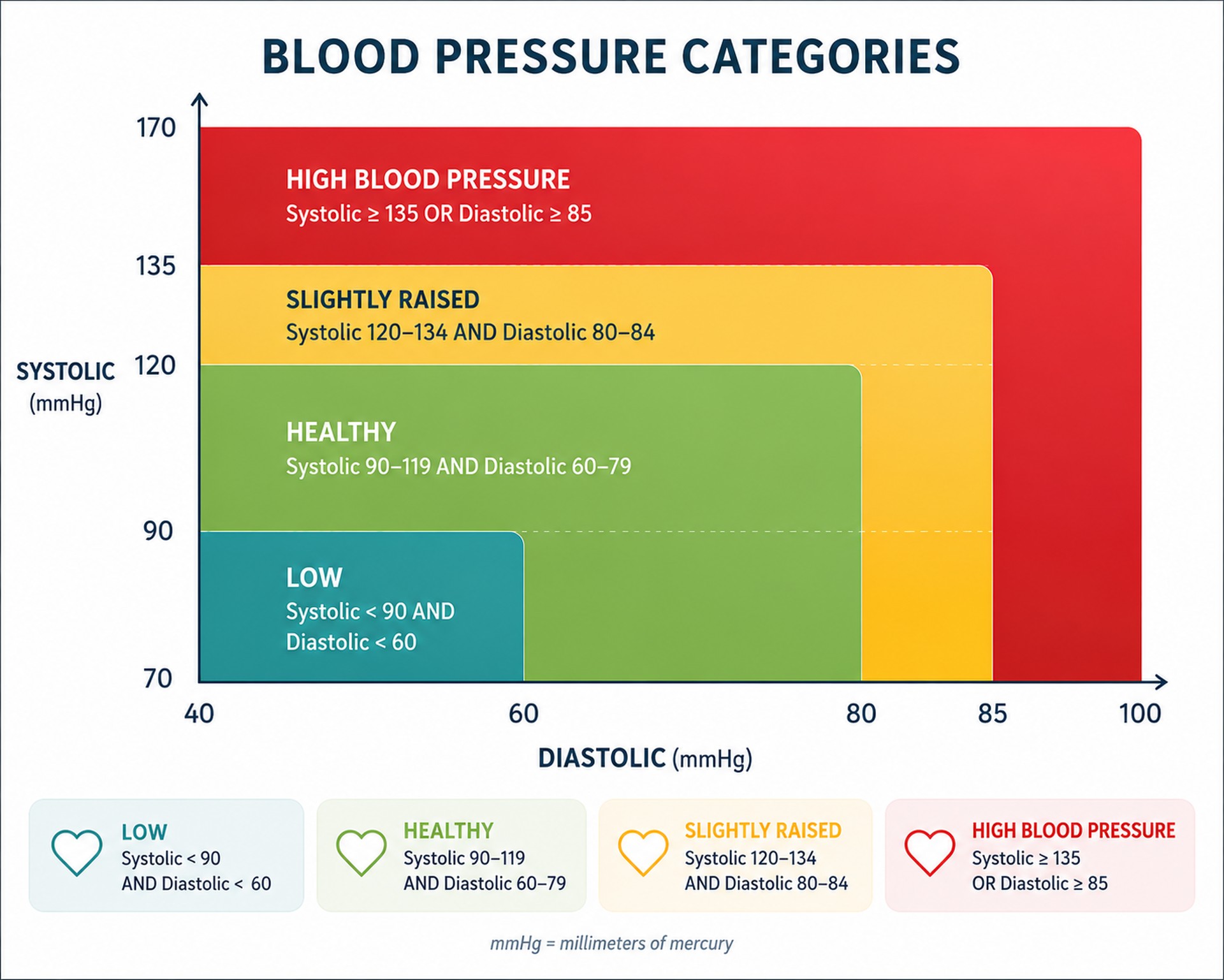
Regular recording of BP is important so that when readings start rising they can be controlled before it gets out of hand.
Common Causes
There are a multitude of causes for hypertension. It is not a one size fits all. Stress, kidney disease, congenital heart disease, medications, birth control pills, lack of exercise, poor food choices, environmental and genetic factors, oxidative stress, lack of certain nutrients. In many cases HT is often called essential hypertension when the cause is not known without extensive investigation.
Complications of Hypertension (HT):
Persistent hypertension is one of the risk factors for heart attacks and stroke (which can cause brain damage). The risk of heart failure is also increased, developing heart (cardiac) disease, the hardening of the arteries, arterial aneurysm, atherosclerosis or arteriosclerosis, eye damage – especially the retina and is a leading cause of chronic renal failure.
Complications of Hypertension: The Importance of Diagnosis and Management
These complications of hypertension are often referred to as end-organ damage because damage to these organs is the end result of chronic (long duration) high blood pressure. For that reason, the diagnosis of high BP is very important so that it can be normalized and prevent complications. Even moderate elevation of arterial blood pressure can lead to shortened life expectancy. Cardiovascular disease (CVD) risks double for each increment of 20/10 points.
In many cases people have no symptoms at all that is why it is often called the silent killer. Testing BP regularly is essential.
Factors to consider:
The Impact of Hypertension on Organ Health
We have miles of blood vessels in our bodies which deliver blood to all our organs. Our organs can be hugely affected by HT, especially the heart, brain, lungs, and kidneys. Over the age of 60, we have a 50% chance of getting HT. HT can be compensating for various issues in our body, e.g., if there is hypoxia (lack of oxygen) the heart pumps harder to increase the oxygen to that organ. So if the BP is then lowered without further investigation, the oxygen-starved organ will get even less oxygen. This can be a reason why many people do not feel good on BP meds – the brain can be especially affected.
It is always important to assess why raised BP is there in the first place. These investigations are complicated and take time, and this is often overlooked. There are some common easily treated reasons which can be addressed. The electrolytes are often low. Both potassium and magnesium. In many instances, normal lab testing will not indicate this. For the magnesium levels, RBC magnesium needs to be tested and not just the serum magnesium. Low Vit D-3 is also a factor.
The majority of diets in the West are low in potassium. These levels need to be increased and 4 g/ day is recommended. A similar issues applies to Magnesium as soils are low and requirements high. Magnesium must also be supplemented.
Vit D-3 is known to be low in populations these days and it is recommended to increase this intake as well.
HT medications can often cause side affects which can acerbate the situation. Diuretics are often given which cause electrolyte issues and can leach out potassium and further as well as magnesum. ACE inhibitors (Calcium channel blockers) are also often used which can also cause side effects.
Nitric oxide also helps lower BP as it is a vasodilator. (some folk genetically have decreased metabolism to make nitric oxide – this can be tested).
⦁ L-Arginine (an amino acid) will help you to make more nitric oxide.
⦁ Garlic will also do this.
⦁ Celery – has a couple of powerful phytonutrients that can help lower BP and reduce adrenaline – so it helps you to sleep.
⦁ Vit E can also assist in lowering BP.
Supplements to consider:
⦁ Magnesium Complex: essential to stabilize the metabolic processes
⦁ Stress Less: support adrenal glands and metabolic functions
⦁ Co-enzyme Q-10 : known to stabilize BP levels
⦁ L-Arginine: to increase nitric oxide levels.
⦁ Vit D-3:
⦁ Vit E:
⦁ Potassium – SallyT product to be launched soon
Addressing Hypertension: The Holistic Approach
To achieve target blood pressure levels, there needs to be a combination of lifestyle changes, pharmaceuticals and nutrition.
Aiming for ideal body weight, exercising, reducing stress levels, sleep hygiene , addition of specific nutrients, restricting caffeine and alcohol intake are all essential and contribute to a well-rounded approach. If still necessary, pharmacologic treatment should be added.
The Risks of Neglecting Hypertension
Playing Russian Roulette and believing that hypertension is not an issue and should not be monitored is foolhardy. The treatment of hypertension is complex and must be treated in a disciplined scientific manner. While using ‘alternative’ therapies, blood pressure must be monitored regularly, and many times these therapies must be combined with conventional allopathic pharmacology.
Medication must not be stopped until blood pressure levels are well within normal limits and even then still monitored. The efficacy of different nutraceuticals can work differently for different individuals. For many who opt for vitamin and mineral supplementation, it can take 2 weeks or so before their effects will be properly noticed. Once beneficial results are stable, dosages could be reduced after time, as long as efficacy is maintained and low blood pressure is still achieved.
It cannot be stressed enough that blood pressure needs to be monitored regularly, especially as we get older. Where does your blood pressure reading sit at?
Stress Less
A comprehensive B-Complex supplement assists in combating all cellular, physiological and emotional stressors to the body. Even unstable blood sugar levels that oscillate through the day is stressful to our bodies at a cellular and metabolic level. By using this high potency B-Complex improved results are secured.
Sally T. Co-Enzyme Q10 100mg
It is a powerful anti-oxidant. It is an all-round catalyst for many metabolic processes. It can promote healthy gums, protectagainst periodontal disease, poor circulation and protects nerves. Assists in providing energy for digestion, helps heal wounds, maintains healthy muscles and many other bodily functions. It is found in all cells but especially in those of the heart tissue. This then improves circulation and strengthening heart muscle. Abundant quantities are found in the mitochondria, the cell’s power house again with higher concentrations is tissues of the heart.
Sally T. Vitamin D3 1000 IU + Co Factors
Vitamin D, especially in its D3 form, plays a crucial role in managing hypertension. It helps maintain arterial flexibility, which is essential for blood pressure regulation. The synergy between vitamin D and magnesium, a combination often lacking in Western diets, is particularly beneficial. Magnesium enhances vitamin D’s effectiveness, further supporting heart health and reducing hypertension risks. Thus, maintaining adequate levels of these nutrients is vital for cardiovascular wellness.